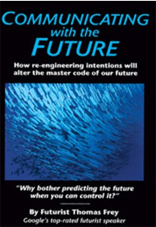

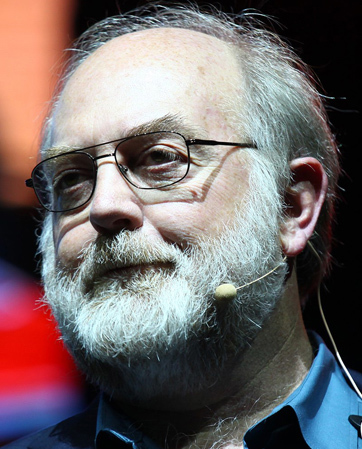
Thomas Frey
- Google’s Top Rated Futurist Speaker
- Innovation Editor, The Futurist Magazine
- Executive Director and Senior Futurist, DaVinci Institute
- City of Colorado Springs
- FSCC Credit Union Retail Delivery Convention
- Florida Workforce Summit
"Thank you for your excellent presentation in Jacksonville. It was a pleasure spending time with you, and your Future of Education speech was extremely well received. 84% of our attendees rated the presentation Good"
-Larry Fairman, Director, Florida Workforce Summit"Tom was great! We received high marks on his presentation! He was appealing and relevant to our audience and a dynamic speaker. It was truly a pleasure to meet him and a pleasure to work with you on getting him to our convention. – "
-– -Rozana Audisho, Public Relations Manager – FSCC Credit Union Retail Delivery Convention


Expanding Our Vision of the Future
Much like dropping a rock into still water and watching the ripples form in every direction, situational futuring begins with a central idea, which grows into a series of rippling thoughts, issues, and questions expanding in every direction. The process begins with an initial scenario and asking some of the standard who-what-when-where-how-and-why questions. Probing deeper, questions formulated around things like timing, monetary implications, disruptive effects, symbiotic partners, who-wins-who-loses, wild cards, policy changes, and strange bedfellows will help expand your thinking even further. Inside these moments of micro-futuring is where the real treasures live. Companies wishing to expand their product line, service agencies seeking to streamline their processes, or design engineers wishing to gain a new perspective will all find this to be a valuable tool.
Future Jobs, Future Industries
We are entering into a world where driverless vehicles will eliminate millions of driving positions; robotic systems will work relentlessly day and night eliminating millions of manufacturing, welding, painting, and assembly positions; and things that seemed impossible to automate in the past will have computers and machines replacing people’s jobs. With these types of automation and AI (artificial intelligence) replacing human involvement, the discussion has focused on solutions like shared jobs, micro employment, and guaranteed income. While those may be options, there’s also great danger in preparing for “slacker lifestyles” where people feel less significant, less certain about their future, and less connected to the value they have to offer. As a society we risk becoming soft and lazy. There is great value in the human struggle, and when we fail to be challenged, our best-laid plans tend to fall apart at the seams. Today, the amount of time it takes to build ships and skyscrapers, create massive data storage centers for all our growing volumes of information, or produce global wireless networks for all our devices has dropped significantly. But along with each of these drops is a parallel increase in our capabilities and our expectations.
The Future of Technology and Innovation
If Steve Jobs had never lived, would we still have the iPhone and iPad today? Similarly, if Walt Disney, George Lucas, and Pete Diamandis had all taken jobs on Wall Street instead of living their lives as true innovators, would we still have Disneyland, Star Wars, and the X-Prize Foundation today? To put it more succinctly, if the visionary never existed, would we still have the industry? Certainly, if Edison hadn’t invented the light bulb, someone else would have. In many cases, inventors have lost out on a patent because of mere minutes separating the timestamp on a patent. So the invention was destined to happen regardless of whose name showed up on the patent, right? Not so fast. The systems we create help define the kind of people who will naturally rise to the top. And these leaders of innovation have decidedly different approaches for making things work. So what would a new system for innovation look like? This talk helps listeners climb aboard a fascinating journey into the forces of change and how they will affect tomorrow’s world of innovation.
Additional Speech Topics for Thomas Frey
A full list of Thomas Frey's speech topics can be viewed here.