
Tobias Moskowitz
- Dean Takahashi Professor of Finance, Yale University School of Management
- Principal, AQR Capital, LLC.
- Research Associate, National Bureau of Economic Research



Past Hosts Include:
- Merrill Lynch
- JP Morgan
- Citadel
- AQR Capital
- American Finance Association
- SALT Conference
- Huron Capital Partners, LLC
- MIT Sloan Sports Analytics Conference
- Stockholm School of Economics
- Copenhagen Business School
“
Toby entertained our audience of CEOs and other executives with an interactive presentation that related sports statistics to metric-driven business decisions we face daily. He has a gift for conveying complex data in an easy-to-follow, conceptual format that challenges conventional wisdom while offering intriguing insight into human behavior and motivations. Highly recommend!
- Huron Capital Partners, LLC
”
More rave reviews
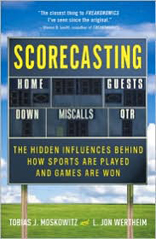
"The closest thing to Freakonomics I’ve seen since the original. A rare combination of terrific storytelling and unconventional thinking. I love this book."
-Steven D. Levitt, best-selling author of Freakonomics and Professor of Economics, University of Chicago"Scorecasting is both scholarly and entertaining, a rare double. It gets beyond the cliched narratives and tried-but-not-necessarily-true assumptions to reveal significant and fascinating truths about sports."
-Bob Costas, NBC Sports commentator
Tobias Moskowitz: AI and the Future of Finance | The American Finance Association - Get Sharable Link
Tobias Moskowitz: AI and the Future of Finance | The American Finance Association

Prof. Tobias Moskowitz - Putting Style-Based Investing into perspective | Uhlenbruch
What Sports Can Teach Us About Business
HBO Real Sports
Talks & Conversations with Tobias Moskowitz

AI and Big Data
- AI and Big Data
-
- Big data explosion – describe all of the new data and the massive amount of it that has been created in the last several years
- More data created in the last two years than the entire history of humankind
- Most of that data is “unstructured” and requires new techniques and methods, such as Machine Learning and AI
- Machine learning and AI
- What is it?
- How does it work?
- Where is it useful?
- Where is it not so useful?
- Some sports examples
- Some other examples
- The challenges and successes of applying this everywhere
- Big data explosion – describe all of the new data and the massive amount of it that has been created in the last several years
- How Does ChatGPT (Large Language Models) Work?
-
- An explanation through examples of how LLMs like ChatGPT work
- Simple and intuitive
- Why it looks like you can “interact” with it and how it mimics human behavior
- What it is and can be used for
- Where it struggles
- How will AI Impact Our Jobs?
-
- A brief history of technology and human labor
- Plato and the written word
- Guttenberg press
- Motor vehicles
- Computers
- Cite academic work on the subject
- Substitute or complement to humans?
- Depends on the industry, job, and most importantly occupation/task
- Evidence from academic studies on its effects
- Projection of what these effects might be/look like in the future
- A brief history of technology and human labor
Decision Making and Behavioral Biases
- What Counts?
-
- “Not everything that can be counted counts and not everything that counts can be counted.” – attributed to Albert Einstein
- Funny anecdotes about measurement and where it goes/has gone wrong
- Rewards to embracing the “hard to measure”
- Why measure? What’s the goal?
- Tim Duncan and the value of a blocked shot
- Covid testing vs. sewage sampling
- Adding complexity, removing complexity, and measuring the impossible
- What’s Luck Got To Do With It?
-
- How the role of luck impacts life in potentially big ways
- How luck helped the 1990 Chicago Bulls create a dynasty
- The luckiest athlete ever – Steve Bradbury
- Attempting to control luck – the plight of Turk Wendell and why baseball players are the most superstitious
- How luck helped create the tech giants of today
- Why we don’t want to base decisions based on luck
- Luck can’t be controlled or predicted
- What’s the #1 reason coaches are fired? Answer: bad luck!
- Same with money managers.
- Same with many other decisions.
- So, how do we avoid these cognitive traps? How do we correctly appreciate the role of luck and make better decisions?
- A blueprint for making better decisions.
- More Than a Gambler’s Fallacy
-
- Fooled by randomness
- Finding patterns where there are none
- Hot hand fallacy
- Gilovich, Valone, Tversky study about basketball shooting
- Steph Curry
- Making bad decisions – chasing fund (short-term) performance
- Exploiting behavioral biases – trend following
- The Gambler’s fallacy – trying to be random/unbiased
- Making bad decisions
- Judges, loan officers, and baseball umpires
- Tinder and dating
- How these biases might affect markets and how to make better decisions once aware.
- Behavioral Science (and Markets)
-
- Contrast rational vs. behavioral view of finance
- Three main behavioral biases related to investing:
- Anchoring and loss aversion
- Overconfidence
- Fooled by randomness
- Illustrate with sports analogies
- Golf (putting for par or birdie), Hockey (pulling the goalie), Football (going for it on 4th down)
- NFL draft, driving, teaching
- Hot hand and gambler’s fallacy
- Illustrate with life analogies
- Apple shuffle feature
- Casinos
- Federal judges
- Dating
- Applied to investing and markets
- Omission Bias and the Power of Doing Nothing
-
- Acts of commission are deemed more harmful than acts of omission
- Examples in medicine, law, business
- Sports – referees
- How this can lead to bad decision making
- How to combat it
- How technology can help and hurt
- Acts of commission are deemed more harmful than acts of omission
- Home Field Advantage and the Power of Identification
-
- Explore the idea of home field advantage
- How present and persistent is it?
- What drives it and explains it?
- How to identify its causes and consequences
- Lessons for business and life
- Lessons for measurement and decision making
- What can we learn from it?
Strategy
- Unconventional Success vs. Conventional Failure
-
- The rewards and risks to unconventional thinking
- Sports
- Cautionary tale: Paul Westhead, Tony Larussa
- Success: Fosbury flop, West Coast offense, Moneyball
- Business
- Cautionary tale: Delorean, Beta max
- Success: Amazon, Tesla, disrupters
- Investing
- Hedge funds
- Private equity
- Long-short, market neutral strategies
- Liquid alternatives
- Diversification
- Sports
- The rewards and risks to unconventional thinking
- Evaluating (and Acquiring) Talent
-
- Sports
- Draft
- Free agency
- Business
- Best practices
- Team concept
- Sports
- Using Sports to Explain How Best to Invest
-
- The NFL draft – a story of diversification
- Unconventional and alternative thinking – the NBA draft
- Combining diversification with alternative thinking – penalty kicks in soccer
- Applied to investing
- Sports Gambling, and What it Can Teach Us About Financial Markets
-
- Response to news
- Under- and over-reaction
- Lottery effects
- Relation to financial markets
- Fantasy sports
- Best Processes
-
- Convey good research process through sports and other examples.
- Process = theory --> model --> data --> new model . . . repeat
- Careful measurement
- Robustness
- Rigorous statistics
- Evolution of methods, data and how to innovate