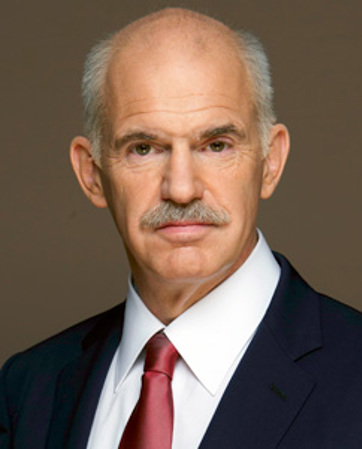
George A. Papandreou is a world leader who has worked tirelessly in pursuing Democracy, Peace, Equality and Freedom through an unparalleled career in global and domestic politics.
The Statesman
George A. Papandreou served as Greece’s Prime minister on the outbreak of the Greek financial crisis, managing to prevent his country from plunging in to bankruptcy, whilst applying a series of structural reforms for modernizing his country. In 2010 he was awarded Germany’s Quadriga Award in the category “Power of Veracity”, for his achievements related to government Transparency. For his efforts to reform Greece he was named one of the Foreign Policy magazine’s TOP 100 Global Thinkers in 2010.
The Global Politician
Currently he is the President of the Socialist International, the largest global political family. The SI brings together 153 social democratic, socialist and Labour parties from all continents. Currently, 53 member parties of the SI are in government and numerous represent the main opposition. The SI has a consultative status - Category I - with the United Nations and works with a large number of other international organizations. Its thematic and geographic Committees are deepening, broadening and promoting particular areas of global policies, optimizing the input of different national experiences. The SI special Commissions on the Global Financial Issues, for a Sustainable World Society and on Inequality, composed of Nobel prize recipients, renowned experts and academics, members of International organizations party leaders, member of governments and Heads of State, are producing special reports with new sets of ideas and policy proposals. By specific initiatives and missions the SI is promoting the peaceful resolution of conflicts and supports the strengthening of democracy, including through election monitoring.
The Innovator
An active supporter of the information society and e-democracy, in 2003 Papandreou was selected as one of the “25 People Who are Changing the World of Internet Politics”. As PM, he established opengov for the first time in Greece, implementing among others:
- compulsory web publication and public consultation of every proposed new law prior to legislation by Parliament
- compulsory web publication of all state decrees, as condition to implication
- compulsory web announcement of all higher government job openings, applications and hiring through a transparent process
- compulsory web publication of all election expenses by political parties.
The Peace Builder
As Minister of Foreign Affairs and Prime Minister of Greece, George Papandreou pursued and initiated action to establish common ground between different countries in the Eastern Mediterranean region and the Balkans.
In 1997, as Foreign Minister, George Papandreou in collaboration with his Turkish counterpart, the late Ismail Cem, achieved a breakthrough in Greek - Turkish relations, initiating a gradual rapprochement following the Imia crisis that brought the two countries almost to the edge of a war.
In 2000 he was widely praised for his diplomatic bridge building and received the Eastwest Institute Peace Building Award, jointly with Ismail Cem, for their unprecedented efforts at improving relations between their formerly rival countries. He also played a key role in the negotiations that led to Turkey’s EU candidacy in 1999 and Cyprus’s entry into the European Union in May 2004.
In 2015, wishing to inspire a new generation of peace builders and honor personalities and organizations contributing to conflict management and stability in the broader region he established with Ismail Cem's family, the Papandreou-Cem International Peace Award.
Following his systematic efforts, in 2003, the European Council adopted the "Thessaloniki Agenda for the Western Balkans: Moving towards European Integration" which represented a major step in relations between Eastern European countries and the EU.
Since the beginning of the nineties, George Papandreou promoted the idea of reviving the Ancient Greek tradition of the Olympic Truce that dates back to 776 BC. In 1996, the resolution of the 50th session of the UN General Assembly supports the idea of building a peaceful and better world through sport and the Olympic ideal and invites all member states to uphold the Olympic Truce during the games.Three years later, the International Olympic Committee, announced the Establishment of the Olympic Truce Foundation and the Olympic Truce Center, where George Papandreou serves as Vice Chairperson.
The Educator
As an MP (1981-2015), he served in several government posts, as undersecretary of Culture and Minister of Education, before becoming Foreign Minister from 1999-2004. He was a champion of 'Free Radio' which was the harbinger of opening up to non-state media in Greece.
As Minister of Education, he founded the Greek Open University, which allowed for all to participate in distance studies for University degrees, he established multi-cultural schools, and instituted a minimum quota for admission of students in Greek universities who were members of the Muslim community in Greece.
The Party leader
George Papandreou was leader of PASOK (Panhellenic Socialist Movement), from 2004 until 2012. During his tenure he brought deep changes to the party by initiating for the first time in European politics, open primaries for the election of the party leader, implementing innovative methods of democratic participation of the grass roots in shaping policies, spreading the use of new technologies for citizen participation in political decision making, promoting educational programs and leadership training seminars for party members and elected cadres.
On January 2015, Papandreou, underlining the need for a groundbreaking change of the Greek political system, created a new party the Movement of Democrats and Socialists, which today is part of a larger alliance under the name of 'Democratic Alignment'.
The Thinker
Inspired by the Ancient Greek "symposium" tradition, since 1998, he convenes an annual gathering bringing together thinkers and decision makers from different backgrounds and origins to debate on crucial topics of the international agenda, aspiring to generate new ideas. Taking place in a different location in Greece every year, the International Annual Symi Symposium, through creative combinations of people and topics, provides participants the possibility to think out of the box in a very informal atmosphere.
Papandreou is a globally recognized expert on the future of the EU, and on the on-going Eurozone financial crisis. He is at the forefront of the discussion of the threat of the dangerous political figures that fuel nativist ethnocentrism and xenophobia. Named as one of Foreign Policy magazine’s “Top 100 Global Thinkers”, he speaks with authority on the future of the European Union with regard to the refugee crisis, economic stability, global security and shifts in geopolitical alliances.
Graduated from Amherst College and holds an M.Sc. in Sociology and Development from London School of Economics. He was a fellow at Harvard University’s Center for International Affairs (1992-1993) and the Institute of Politics (2012). In 2013, he served as a Global Fellow and Adjunct Professor at Columbia University's School of International and Public Affairs as well as a faculty member in the Master of Public Affairs program at Sciences Po in Paris.
He speaks Greek, English and Swedish.
RECENT - CURRENT INTERNATIONAL ACTIVITY
- President of Socialist International
- Vice-Chairperson of the International Olympic Truce Foundation (IOTF)
- Founding Member and Commissioner of the Global Commission on Drug Policy (GCDP)
- Council Member of the European Council on Foreign Relations (ECFR)
- Member of the Sustainable Development Solutions Network (SDSN)
- Member of the Board of Directors of Mercy Corps
- Advisory Member of the Global Education and Skills Forum (GESF)
- Member of the Aspen Ministers Forum
CURRENT PROJECTS: Inclusive Leadership Training
- He currently is developing a school for young leaders, through inclusive and democratic leadership training, sustainable policy development as well as building networks beyond borders, in particular in the wider region of the Mediterranean and the Balkans.