
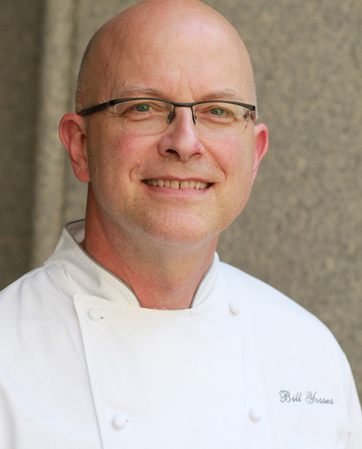
Bill Yosses
- Former White House Executive Pastry Chef
- Founder, Kitchen Garden Laboratory
- High Profile New York City Chef


History in the Baking: Culinary Diplomacy
Culinary diplomacy is as old as diplomacy itself. From the days of Talleyrand and before, food and drink has been used at the highest levels of government as a powerful force to persuade and influence policymakers. Today is no different. With his bird’s eye view to history and as a member of the U.S. State Department’s Culinary Diplomatic Corps, Bill shares his first-hand experiences, anecdotes and observations about the power of the party at the White House, Camp David and embassies in Washington, D.C. and around the world.
Have Your Cake and Eat It, Too: Creating a Food Literate America
Why should a dessert chef have a place in the conversation about healthier eating? Because Americans need both a rethink and a reboot about what a balanced approach to food really means. When you consider the extreme relationship many Americans have with food — unsuccessful crash diets on the one hand and overeating that leads to obesity and diabetes on the other -— it’s clear that the reductionist approach that vilifies certain foods doesn’t work. In this talk, Bill illustrates the balanced relationship many other cultures have with eating and drinking (the French with baguettes and butter, the Italians with pasta, the Belgians with chocolate), presents a path forward for Americans and shows the audience it can be mindful of healthful eating yet not miss out on one of life’s great pleasures — dessert.
The Science of Cooking
In a science and technology-driven world that demands each of us be science literate, Bill, a pioneer of the “chef-scientist” movement, uses food as an important prism to understanding science and, conversely, science as a gateway to understanding food. Building on the groundbreaking work of author Harold McGee, Bill takes the audience on a fascinating adventure into understanding food on the cellular, molecular and atomic level. Exploring scientific principles such as crystallization, surface tension, density and viscosity, he demonstrates how understanding the “science behind the food” actually helps chefs improve their own cooking.
The Progressive Culinary School: Chefs, Social Responsibility and Therapy for America’s Ailing Food System
The $20 billion Americans spend on processed foods in the first half of their lives is a counterpoint to the $20 billion they spend on healthcare at the end of their lives {to treat the diseases associated with such foods? — Bill can we say this?} What is wrong with this picture? Much of it stems from a lack of understanding of where food comes from and why whole foods are a key component to good health. A key player in the Obama Administration’s “Let’s Move” initiative to reduce diabetes and promote health and wellness around eating, Bill is a proponent and stakeholder of “intelligent agriculture.” As a chef, he communicates through the palate and on the plate. Flavor, aroma and texture, all important to health, are the language chefs speak and that language is being confused by a weakened selection of ingredients. In this talk, Bill examines the food system — from modern agricultural methods that employ GMOs and fertilizers to the microbiology of soil and the need for biodiversity — and offers advice for a more naturally harmonious system of agriculture that can meet the challenge of feeding the planet’s projected nine billion people by 2050.
The White House State Dinner: Lessons in Soft Power
The term “soft power” is exemplified by the East Wing of the White House where elaborate State Dinners are conceived and executed by diverse, talented staff. The East Wing is nothing if not an exceptional example of the professional hospitality industry at its finest. Having worked for two First Ladies, five White House Social Secretaries and countless florists, caterers and sommeliers, Bill shares an insider’s view on the levers of soft power — planning, coordinating and implementing international dinner parties with some of the most important players in the world on the grandest of scales.