
Beau Lotto
- Renowned Neuroscientist, Entrepreneur, and Professor of Neuroscience at the University of London
- Three-Time TED Main Stage Speaker with over 9Million Views
- Founder and CEO of The Lab of Misfits, the world’s first neuro-design studio that offers brands science-backed insights to foster innovation
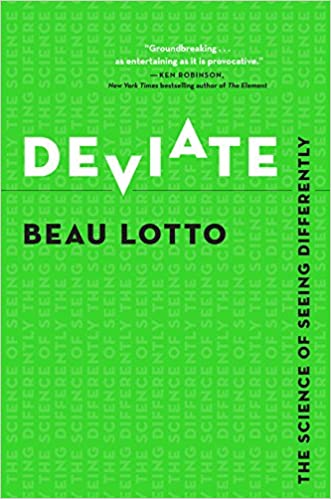
- Author of Deviate: The Science of Seeing Differently


- World Economic Forum
- Warner Music
- Universal
- Viacom
- Sainsburys
- Microsoft
- Apple
- UAE’s Crown Court
- Cannes Lions Creativity Festival
"Beau is a perfect, positive start to the day. I have chaired conferences for over 20 years and this is undoubtedly one of the best keynotes I have ever seen. Beau began the second day of our conference – when people may be low on energy – and within moments over 800 people were engaged. By the end of the talk, they were also informed, challenged and inspired. Beau provided the hope that change is possible, along with a road map to making it happen. Our delegates left the plenary session feeling positive and primed for the rest of the day. Very few experts can also speak, entertain and inspire. Beau does."
-Learning Technologies Conference, London"Your keynote presentation was the top-rated session of ISF Congress in Rotterdam. Your session delivered exactly what we needed from a great keynote. Members were entertained by your stylish delivery and inspired by your content. Member quotes included the following: “Great and interesting speech, bringing your own way of thinking and approaching things on to a new way. Never thought of it the way it was presented.” “Engaging and inspiring “ “Fascinating and engaging! What a great start to the day."
-Information Security Forum Limited"The initial request was to kick start the Summit in a different way and to radically challenge the leaders to “unlearn” social conditioning and personal perspectives and approach the following days at the conference with a more open mindset to help encourage different solutions to business challenges. Beau’s deep knowledge and insight on his topic shines through; and is perfect to support audiences in breaking out of old habits of thinking and embracing more diverse ones. In my opinion, the topics that Beau touches on is the future for healthy organisations and I would say his content is relevant to any business that wants to shake up their teams to think differently, embrace change and recognise the beauty in stepping out of constraints."
-Boeringer Ingelheim"Captivating from the moment he took the stage during our recent Leadership Summit, Beau delivered a fascinating and illuminating presentation that set the tone and became a major topic of conversation thereafter. Through his unique perspective, he challenged each and every attendee to think differently about how they see, experience, and engage with people, and the world at large. Finding the right speaker who can engage such a large group (100+ people) is no easy task but Beau delivered – and has left a lasting and thought-provoking impression on us all."
-Purolator"Thank you kindly for blowing the socks off our participants, and frankly, my colleagues and the head of Metro Vancouver (both CEO and politicians). Well done! You were ‘outside’ the box of the kind of keynotes we typically have for our Zero Waste Conference – and I felt you were going to offer just the right antidote to the crazy fear and uncertainty everyone has been feeling over the past few months. You were an answer to our uncertainty – and literally. Some of my colleagues and our regional gov’t leadership were uncertain whether we should have someone that was not deeply rooted in the CE/Waste prevention issue. Wow, talk about everyone coming full circle into ‘certainty.’ People loved your presentation! Wish you could see some of the chat!"
-Metro Vancouver and the National Zero Waste Council"The truth to describe his time here as like having a Renaissance man in our midst – Beau blends art, science, curiosity, illusion and music to entertain children, adults and scientists alike."
-London Science Museum"Beau was great to work with – very creative, highly ambitious and with incredible energy. His communications skills are quite something to behold: when dealing with the volunteers from the public for the experiment, he held them in the palm of his hand and infected them with his enthusiasm. Respected by his peers and looked up to by his students he is someone who people like to listen to and learn from. I’d love the chance to work with him again."
-BBC"What a knockout! The feedback from all the members was fantastic..!"
-Tech UK


Risk/Uncertainty
One of the most dangerous things one can experience in life is doubt. During evolution, if your ancestors weren’t sure whether that ‘thing over there’ was a predator, well … it was too late for them. Thus, we hate doubt … and that’s usually a good idea (throughout evolutionary history).
We are genetically programmed to do so: Sea-sickness, and indeed most of our mental health problems being direct manifestations of our fear. The deep irony, however, is that nothing interesting begins without it. So taking the risk to step into uncertainty is an essential aspect of adaptation, which we know is at the root of success in all natural systems. What’s more, nature also tells us when it’s best to risk uncertainty. So how to deal with uncertainty is the fundamental problem that your brain evolved to solve. Here we discuss in a highly experiential way how and why everything is uncertain, and nature’s solution to it.
Adapt or Die
The future is unknown. It always has been and always will be. Whether technological innovation, wars, climate change, voting … or a pandemic, every decision an organization and leader makes is, in one way or another, directly related to uncertainty.
In nature, the most successful systems do not just adapt, they are adaptable. Indeed, adaptability is the ‘skill’ most sought by leaders and organizations. To adapt requires stepping into uncertainty. Adapting to uncertainty is born out of a way of being … a practice … that one engages in every day at work, at home with one’s children, with one’s partner, friends, with the cashier in the grocery store.
Only by understanding how and why you see what you do can you adapt to and lead others into uncertainty. Becoming perceptually intelligent in conflict enables leaders and their teams and organizations to succeed when others fail.
Change
There is no inherent value in change. Whether change is good or bad is – like everything else in life – context-dependent. Here, using principles in behavioral and perceptual neuroscience, we’ll explore what lives at the heart of change: why it’s often essential for success but equally the most feared of human activities. Indeed, to ask ‘why?’ is historically the most dangerous thing you can do. Hence, organization, businesses, religions and even our education systems are designed to reduce question-asking. And yet all revolutions (and revelations) begin with a joke (“you mean it could be different from this?”).
See how and why questions and metaphor are mediators of change; what makes a good question; and how change – when properly pursued – has no direction or goal. Which means change is personal and – when properly considered – inevitable.
Leadership
What makes a good leader? When asked this question of a diverse audience, I’ll receive many different possible qualities that are ‘essential’. And yet, there are only three such descriptions that correlate with the success of a company. What are they and why do they matter?
Here we will address these questions from the perspective of behavioral neuroscience, and consider a new answer: the quality of a leader is defined by how he/she leads others into uncertainty.
How To See New Meaning In Data
There is no inherent value in any piece of information! Data is meaningless. Why? This is because the brain deals with meaning and not information since information doesn’t tell you what to do. In fact, THE fundamental challenge that the brain evolved to solve is to take meaningless data and make it meaningful. This is true even at the most basic level of our senses: seeing light. Which is why we never see the world in any direct sense. Instead what we see is the meaning of information grounded in our personal, cultural and evolutionary histories. And it’s the historical meaning of stuff that we literally see, experience and know (not the stuff itself).
Here we’ll explore – and experience – how to see new meaning in data that has always been there, but remains hidden. The result will be an understanding of the principles by which the brain makes the meaningless meaningful.